
Posted June 25, 2026 | Category: Common Mistakes | Tags: String Lights, Outdoor Lighting, Waterproofing, Product Design
Quick Answer
Detachable bulb-and-cable string lights are a common source of outdoor lighting failure. The connection point between the bulb and cable is a natural weak spot where moisture, rain, and condensation seep in over time — causing blown bulbs, damaged cables, and costly replacements.
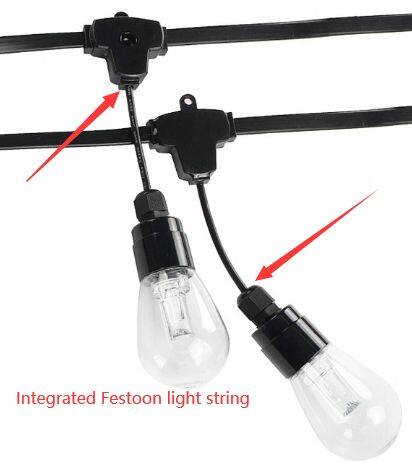
The fix: Choose integrated S14 string lights where the bulb and cable are molded as one piece. No detachable joint = no entry point for water.
The Painful Feedback
A client recently shared some difficult news with us.
They had purchased string lights with a detachable bulb-and-cable design for an outdoor installation. The lights looked great on paper — flexible, easy to replace individual bulbs, and cost-effective.
But after the first heavy rain, things went wrong.
Water had seeped into the connection points between the bulb and the cable. The result:
Blown bulbs
Damaged cables
Significant replacement costs
Labor time for reinstallation
Business downtime
This wasn't a small loss. It was substantial enough to make them reconsider their entire approach to outdoor string lighting.
Why Detachable Designs Fail Outdoors
The problem is not a manufacturing defect — it's a design limitation.
Water ingress happens slowly. It doesn't require full submersion:
Rain spray during storms
Condensation from temperature changes
Humidity in coastal or wet climates
Splash from ground-level water
Over weeks or months, moisture accumulates inside the connection, causing corrosion, short circuits, and eventual failure.
The separation point between bulb and cable is the weak spot. This is not a rare case — it's a predictable outcome for any detachable outdoor lighting product.
The Common Mistake
Many buyers assume that:
"Waterproof" rating on the bulb = the whole fixture is waterproof
Detachable design = flexibility = better
Individual bulb replacement = lower long-term cost
These assumptions are incorrect for outdoor use.
The reality is:
Waterproof rating on individual components does not guarantee the connection point is sealed
Flexibility at the connection point creates vulnerability
Individual bulb replacement costs are dwarfed by labor and downtime from system-wide failure
The Integrated Solution: S14 String Lights
The alternative is an integrated design — where the bulb and cable are molded as a single piece.
Feature | Detachable Design | Integrated Design |
|---|---|---|
Connection point | Yes – vulnerable to water | No – molded as one piece |
Water ingress risk | High | Zero (no entry point) |
Repairability | Bulbs can be replaced individually | Whole unit replaced if damaged |
Cost | Lower upfront | Slightly higher upfront |
Total cost of ownership | Higher (frequent failures) | Lower (long-term reliability) |
Best for | Indoor or temporary use | Permanent outdoor installations |
What Is S14?
S14 refers to a standard string light design where the bulb housing is integrated into the cable. The bulb and cable are one continuous piece — no detachable joint, no entry point for water.
This design is:
Permanent: Not intended for disassembly
Weatherproof: No weak points for moisture ingress
Reliable: Fewer failure points
Is It More Expensive?
Yes, slightly.
But compare that cost to:
Replacing dozens of bulbs after one rainstorm
Paying for labor to reinstall new lights
Dealing with business interruption
Replacing the entire system after repeated failures
The integrated design pays for itself.
The 1 Question Every Buyer Should Ask
If you are sourcing string lights for outdoor use — whether for a commercial facade, a holiday display, a restaurant patio, or a permanent landscape installation — ask your supplier this one question:
"Is the bulb detachable, or is it integrated with the cable?"
The answer could save you thousands of dollars in replacement costs.
If the answer is "detachable" : Proceed with caution. Understand the risk of water ingress and ensure the installation is sheltered from direct rain and moisture.
If the answer is "integrated" : This is the right design for permanent outdoor use. No weak points, no water entry, no unexpected failures.
Common Installation Mistakes to Avoid
Mistake 1: Using Indoor Lights Outdoors
Even if the bulb is rated "waterproof," indoor-rated string lights have less durable cable insulation and poorer sealing at connection points. Always check the product's outdoor rating.
Mistake 2: Assuming "Waterproof" Means "Submersible"
IP44 is splash-proof. IP65 is water-jet resistant. IP67 is submersible. Understand the difference before specifying — and know that IP rating alone does not guarantee connection-point sealing.
Mistake 3: Ignoring the Cable Quality
Even with an integrated design, poor quality cable will degrade under UV exposure or temperature extremes. Specify UV-stabilized, outdoor-rated cable for any permanent installation.
Mistake 4: Forgetting the Installation Details
Water can pool in cable trays, at connection points, or where cables bend downward. Ensure drip loops and proper mounting orientation to prevent water from running into the fixture.
Real-World Cost Comparison
The integrated design costs more upfront but delivers significant savings in the long run.
Summary Table
Your Application | Recommended Design | Why |
|---|---|---|
Indoor / covered patio | Detachable (acceptable) | Limited moisture exposure |
Outdoor / seasonal (under cover) | Detachable (with caution) | Check weather conditions |
Outdoor / permanent (rain-exposed) | Integrated S14 | No weak points |
Outdoor / commercial facade | Integrated S14 | Reliability is critical |
Coastal / high-humidity | Integrated S14 | Corrosion resistance needed |
Contact Us
Looking for reliable string lights for your outdoor project? We can help you select the right design — whether detachable for temporary use, or integrated for permanent installations.