
Intelligent Control Solutions

Complete control system solutions for LED lighting projects—from single-fixture control to full-scene intelligent integration.
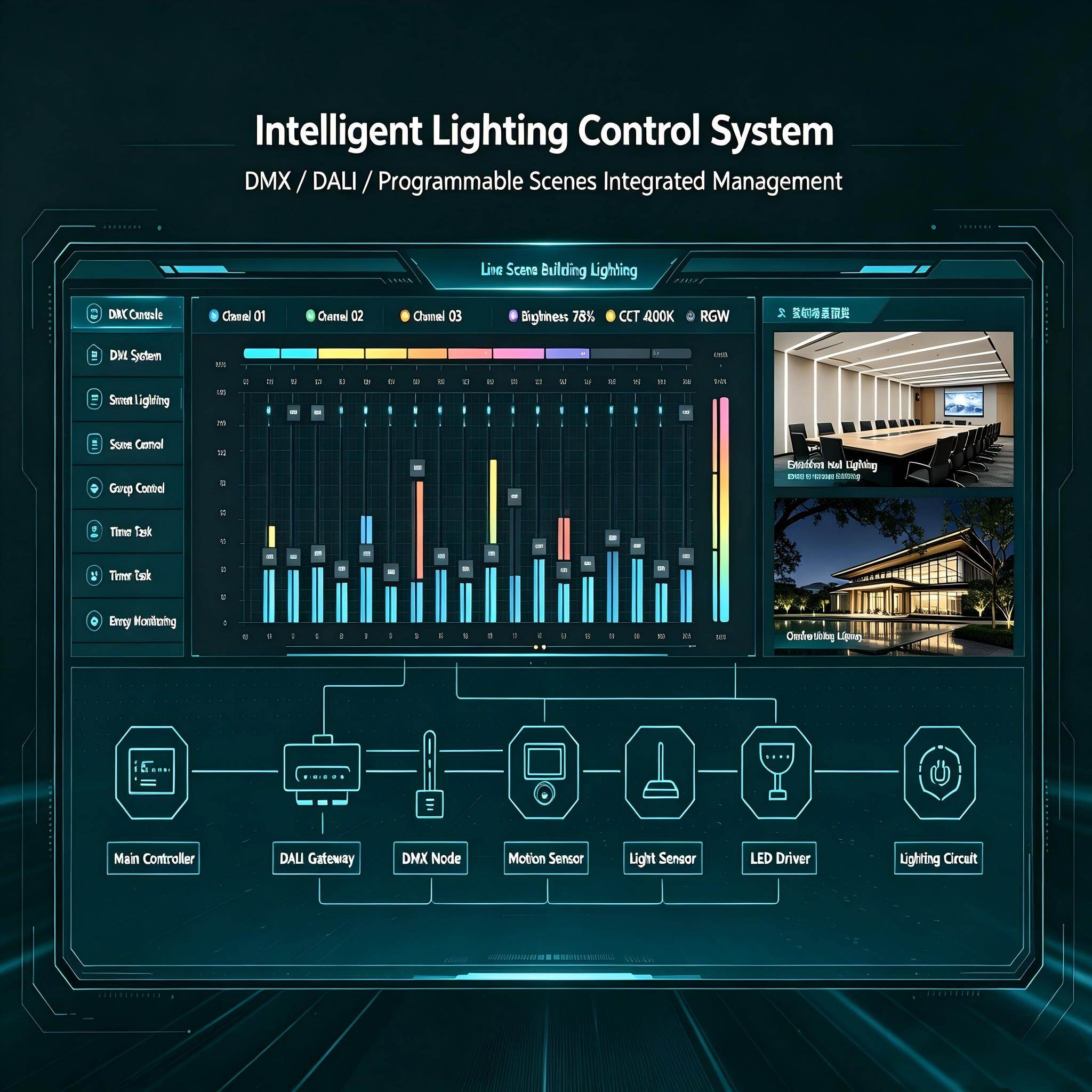
Why Choose Our Control Solutions

Professional integration expertise with comprehensive protocol support and end-to-end technical service

Comprehensive Protocol Support

Support for DMX512, DALI, 0-10V, KNX, and wireless protocols (Zigbee/Bluetooth) to meet diverse project requirements.

Flexible Scenario Adaptation

Suitable for architectural lighting, commercial spaces, hotels/residences, stage performance, and various other applications.

Integrated Hardware & Software

Control solutions deeply integrated with our LED fixtures and power supplies for maximum system stability.

Professional Commissioning Support

End-to-end technical support from system design to on-site programming and debugging.

Our Control Technology Partners

Collaborating with leading Chinese LED controller manufacturers

LTECH
LT
Xinbo Light
XB
Yumingxin
YM
Mingrui
MR
Bincolor
BC
Siboer
SP

Application Scenarios

Tailored control solutions for diverse lighting environments

Architectural & Facade Lighting

DMX512 control systems for building synchronization and dynamic color effects.

Commercial & Office Lighting

DALI/0-10V dimming systems with sensors for energy efficiency and comfort.

Hotel & Premium Residences

Wireless smart control systems for whole-house lighting scenes and automation.

Stage & Performance Lighting

Professional DMX512 consoles for complex programming and real-time control.

Control Insights

In-depth technical content on control systems, dimming protocols, and intelligent lighting — helping you design and specify the right control architecture for your project.

Technical Guide10 min read

A Practical Guide to Selecting LED Control Systems

The control system is the brain of any LED lighting installation. It determines how lights respond to user input, how scenes are programmed, and how multiple fixtures coordinate. Choosing the right control protocol is one of the most consequential decisions in a lighting project — it affects everything from installation complexity to long-term maintainability. This guide compares the three most widely used dimming protocols and provides a framework for selection.

1. DMX512: The Standard for Dynamic and Entertainment Lighting

DMX512 (Digital Multiplex) is the most widely adopted protocol in stage, entertainment, and architectural dynamic lighting. It supports up to 512 channels per universe, with each channel providing 256 levels of control (0–255). DMX512 excels in applications requiring precise, real-time control of color, intensity, and movement across many fixtures simultaneously.

Key strengths include high channel density, real-time response with no perceptible latency, and an extensive ecosystem of controllers, software, and compatible fixtures. DMX512 is the go-to choice for stage productions, concert venues, architectural media facades, theme parks, and any application where dynamic color changes and complex lighting sequences are required.

Limitations include the need for dedicated cabling (typically RS-485), limited addressing range per universe (requiring multiple universes for large installations), and the fact that it is a one-way communication protocol — the controller sends commands but receives no feedback from fixtures.

2. DALI: The Standard for Commercial and Office Lighting

DALI (Digital Addressable Lighting Interface) is a two-way digital communication protocol designed specifically for building lighting management. Each DALI device has a unique address, allowing individual control and status feedback. The protocol supports up to 64 devices per segment and enables grouping, scene storage, and daylight harvesting.

DALI's key advantage is its two-way communication: the control system can query each fixture for status, fault conditions, and operating hours. This makes DALI ideal for commercial buildings, offices, hospitals, and warehouses where energy management, maintenance monitoring, and automated scheduling are priorities. DALI-2, the latest standard, adds improved interoperability and support for emergency lighting.

DALI is less suitable for applications requiring rapid color changes or high-speed effects, as its communication speed is optimized for steady-state control rather than real-time animation.

3. 0-10V: The Simple Analog Solution

0-10V is an analog dimming protocol that uses a DC voltage signal (0V = off/dim, 10V = full brightness) to control light output. It is the simplest and most cost-effective dimming method, requiring only two additional low-voltage wires alongside the power conductors.

0-10V is commonly used in commercial and industrial applications where basic dimming is needed without complex programming — such as conference rooms, classrooms, and warehouse high-bay lighting. It is compatible with a wide range of LED drivers and is often integrated into building management systems (BMS).

Limitations include the lack of individual fixture addressing (all fixtures on the same circuit dim together), no feedback capability, and potential voltage drop issues over long cable runs. It is not suitable for applications requiring scene control, individual fixture management, or dynamic effects.

4. How to Choose: A Decision Framework

When selecting a control protocol, consider these key questions: Does the project require dynamic color changes and real-time effects? Choose DMX512. Is individual fixture control, status monitoring, and energy management important? Choose DALI. Is simple, cost-effective dimming sufficient? Choose 0-10V.

Many professional installations combine multiple protocols — for example, using DALI for general office lighting and DMX512 for a lobby media facade. The key is to define the functional requirements of each zone independently, then select the protocol that best matches those requirements. Working with an experienced control system integrator ensures compatibility, proper addressing, and reliable long-term operation.

Complete Lighting Ecosystem

When custom LED fixtures, certified power supplies, and intelligent control systems work together, you get a complete, reliable, and future-ready lighting ecosystem.