
Estimated reading time: 8 minutes
Quick Answer
Choosing the right aluminum profile for your LED strip project comes down to three key factors: thermal management (wall thickness and material grade), optical quality (diffuser selection), and installation environment (indoor vs. outdoor). For most commercial projects, a 1.5mm wall thickness 6063-T5 aluminum profile with a milky white diffuser provides the best balance of heat dissipation, light quality, and durability. For outdoor applications, ensure wall thickness ≥1.5mm, IP65+ rating, and proper end cap sealing to prevent water ingress.
Introduction: Why Aluminum Profiles Matter
When designing LED strip lighting installations, the aluminum profile is often overlooked—yet it determines the success or failure of your project. It serves three critical functions:
Heat dissipation: LED strips generate significant heat. Without proper thermal management, junction temperatures can exceed 80°C, reducing lifespan by up to 50% and causing color shift .
Optical quality: The diffuser transforms harsh point-light sources into smooth, even illumination.
Structural integrity: Provides a clean, professional mounting solution that protects the LED strip from physical damage.
For B2B buyers, selecting the right profile isn't just about aesthetics—it directly impacts product longevity, customer satisfaction, and warranty claims.
Understanding Thermal Management: The Physics Behind Heat
LEDs convert only about 25–35% of input energy into light—the rest becomes heat . A 15W/m LED strip generates approximately 10W/m of heat load. Without proper dissipation, PCB temperatures can exceed 80°C, causing:
Accelerated lumen depreciation
Visible color shift
Lifespan reduction of up to 50%
Wall Thickness: The Critical Variable
Wall thickness directly affects both structural strength and thermal performance:
Wall Thickness | Suitable For | Thermal Performance |
|---|---|---|
<1.0mm | Indoor decorative, temporary use | Poor—rapid heat buildup |
1.2mm | Minimum engineering standard | Marginal for ≤12W/m strips |
1.5mm | Mainstream commercial standard | Good for 15–18W/m, 1–1.5m lengths |
≥2.0mm | High-power (20W/m+), outdoor, long runs | Excellent—30–40% longer LED lifespan |
Upgrading from a 1mm to 2mm 6063-T5 profile can reduce LED PCB temperature by 6–8°C at 15W/m load—enough to extend L70 lifespan by 30–40% .
Material Grade: 6063-T5 is the Minimum
The aluminum grade matters as much as thickness. 6063-T5 aluminum has a thermal conductivity of approximately 201 W/(m·K)—over 1,000 times higher than plastic . Avoid recycled aluminum or unspecified grades, which can have conductivity below 150 W/(m·K) and significantly reduced heat dissipation efficiency.
Selection guide: For any LED strip exceeding 10W/m, demand 6063-T5 aluminum with verified wall thickness. If you cannot verify the material grade, request an MSDS or test report.
Diffuser Types: Getting the Light Quality Right
The diffuser determines the visual quality of your lighting. It also directly affects system output—some diffusers reduce light transmission by 25–35%.
Diffuser Type | Light Transmission | Best For |
|---|---|---|
Clear | ~90% | Maximum brightness, visible LEDs |
Milky White | 65–75% | Smooth, uniform light; "see the light, not the source" |
Frosted | 70–80% | Balanced diffusion and output |
Prismatic | 85–90% | Directional control, glare reduction |
For most architectural and commercial applications, milky white diffusers are the preferred choice. They eliminate visible LED dots and create a professional, homogeneous light line.
Pro tip: Avoid cheap diffusers that appear hazy or gray. High-quality PC diffusers maintain clarity and UV resistance over time.
Indoor vs. Outdoor: Critical Differences
Indoor Installations
Minimum wall thickness: 1.0–1.2mm (1.5mm recommended for high-power strips)
Diffuser: Milky white PC for uniform light
Mounting: Surface-mount or recessed
IP rating: IP20 generally sufficient
Application examples: Cove lighting, under-cabinet illumination, display cases, retail shelving
Outdoor Installations
Minimum wall thickness: 1.5mm (1.2mm absolute minimum)
Material: 6063-T5 aluminum with anodized or electrophoretic coating (≥10μm oxide layer) to prevent corrosion
Sealing: End caps with silicone gaskets—thin-walled profiles cannot maintain proper seal integrity
IP rating: IP65 minimum, IP67 for areas with direct water exposure
Application examples: Building facades, landscape lighting, bridge outlines, sign channels
Warning: Many outdoor lighting failures are caused by water ingress at end caps. A profile with inadequate wall thickness (under 1.2mm) will not maintain proper seal compression, allowing moisture penetration and corrosion.
Profile Cross-Section Types: Which Shape to Choose
Profile Type | Best For | Light Distribution |
|---|---|---|
U-Shape | General indoor use, cove lighting | Even, wide spread with optional diffuser |
V-Shape / Corner | Tight spaces, corners, furniture | Angled projection, space-efficient |
L-Shape | Edge lighting, wall washing | Directional, focused |
Flat / Surface-Mount | Under-cabinet, shelves | Direct downward illumination |
U-shaped profiles with curved reflection chambers provide superior light uniformity and reduced glare . For installations where space is extremely limited (under 15mm clearance), V-shaped profiles as small as 8×8mm are available .
Recommended Profile: Best-Selling 10mm LED Strip Profile
For 10mm LED strips—one of the most common widths in commercial installations—we recommend this best-selling aluminum profile.
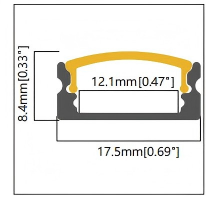
Key specifications:
Parameter | Specification |
|---|---|
Application | 10mm LED strips |
Material | 6063-T5 aluminum |
Wall Thickness | 1.5mm |
Finish | Anodized (silver or black) |
Diffuser | Milky white PC (frosted optional) |
Mounting | Surface-mount and recessed compatible |
Standard Length | 1m (customizable) |
Why This Profile Works
Feature | Benefit |
|---|---|
1.5mm wall thickness | Handles strips up to 18W/m with safe thermal margins |
6063-T5 aluminum | 201 W/(m·K) thermal conductivity—industry standard |
U-shape design | Even light distribution, easy installation |
Milky white PC diffuser | Professional, glare-free illumination |
Accessories | Mounting clips, end caps, connectors included |
This profile is the first choice for professionals needing reliable, good-looking, long-lasting LED strip installations. It meets the structural and thermal requirements for most commercial projects.
Installation Best Practices
Step 1: Measure and Plan
Account for connection points and power supply locations
Plan for thermal expansion with appropriate gaps
Use a spirit level for straight alignment
Step 2: Cut Precisely
Use a fine-tooth saw with a guide for clean cuts
Deburr cut edges to prevent damage to the LED strip
Step 3: Mount Securely
Clean the mounting surface thoroughly before installation
For outdoor installations, pre-drill mounting holes to avoid compromising the seal
Use stainless steel screws for outdoor applications
Step 4: Install the LED Strip
Clean the profile interior before installing the strip
Press the strip firmly to ensure good thermal contact
If using adhesive, apply even pressure across the entire length
Step 5: Attach the Diffuser
Align the diffuser carefully before snapping into place
For IP-rated installations, seal end caps with appropriate sealant
Common Mistakes to Avoid
Mistake | Consequence | Solution |
|---|---|---|
Using profiles with wall thickness under 1.0mm for high-power strips | Rapid heat buildup, LED failure within months | Use ≥1.5mm wall thickness for strips >10W/m |
Choosing clear diffusers for visible installations | Harsh spots, cheap appearance | Use milky white diffusers for professional look |
Skipping end caps on outdoor installations | Water ingress, corrosion, short circuits | Always install sealed end caps for outdoor use |
Mixing recycled aluminum without 6063-T5 verification | Unknown thermal performance, potential failure | Demand 6063-T5 alloy verification |
Not verifying oxide layer thickness for outdoor use | Surface corrosion within 6–12 months | Require ≥10μm anodized or electrophoretic coating |
Technical Specification Checklist
When specifying LED profiles for your project, include:
LED Aluminum Profile Specification Requirements:
Material: 6063-T5 aluminum alloy
Wall Thickness: ≥1.5mm (≥1.2mm minimum for indoor low-power)
Finish: Anodized or electrophoretic coating (≥10μm for outdoor)
Diffuser: Milky white PC (frosted or clear optional)
IP Rating: IP20 (indoor) / IP65–IP67 (outdoor)
Compatible LED Strip Width: 8mm / 10mm / 12mm (specify as required)
Mounting: Surface-mount or recessed
Length: Custom per project
Summary
Consideration | Indoor Use | Outdoor Use |
|---|---|---|
Minimum Wall Thickness | 1.2mm | 1.5mm |
Recommended Material | 6063-T5 aluminum | 6063-T5 aluminum |
Diffuser | Milky white PC | Milky white PC (UV-resistant) |
End Caps | Optional | Required (sealed) |
IP Rating | IP20 | IP65 / IP67 |
Surface Treatment | None or anodized | Anodized or electrophoretic (≥10μm) |
Mounting Hardware | Standard | Stainless steel screws |
Explore Our LED Profile Sample Kits
See the quality firsthand. We offer free sample kits for qualified projects — allowing you to test fit, finish, and compatibility before you commit.
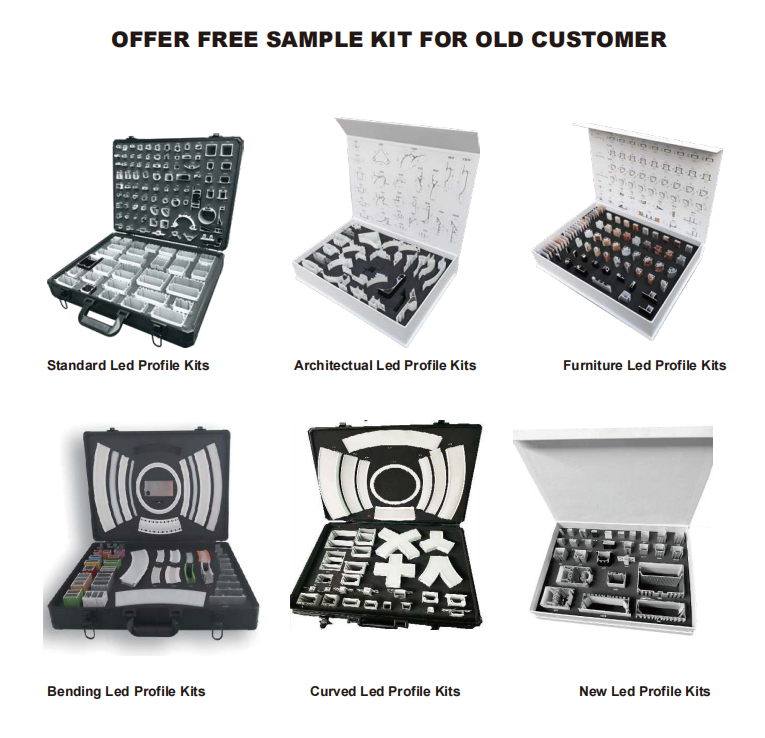
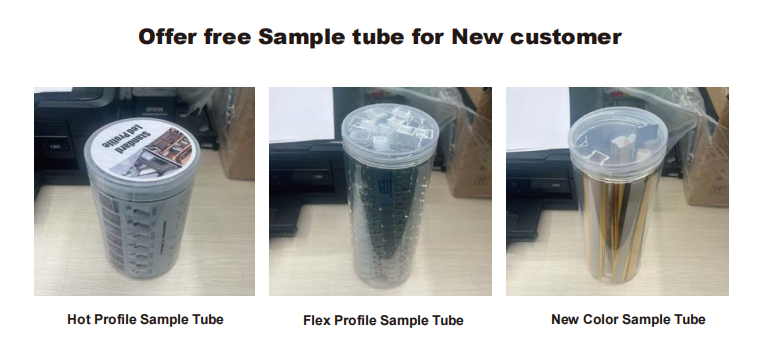
📐 Detailed dimension drawings are available for every profile. Contact us to request specific size specifications or to arrange a sample kit for your project.
Related Content
Contact Us
Need help selecting the right aluminum profile for your specific LED project? Our engineering team can analyze your requirements and recommend the optimal solution.