
Posted July 27, 2026 | Category: Control Solutions | Tags: LED Controllers, DMX512, DALI, Lighting Control
Quick Answer
Selecting the right LED controller depends on your project scale, control protocol requirements, and application environment. For architectural and commercial lighting, the choice often comes down to project complexity: simple standalone projects may only need basic controllers, while large-scale installations require systems with strong networking capabilities and extensive partner ecosystems. Understanding each brand's strengths—whether it's a focus on smart home ecosystems, large-scale urban lighting, or comprehensive system integration—helps you match the right partner to your project.
Introduction: Why LED Controllers Matter
In any LED lighting system, the controller is the "brain"—determining what effects are possible, how reliably the system performs, and how easy it is to maintain. The global LED controller market is projected to reach $693 million by 2029, growing at a compound annual growth rate of 17% . As LED modules become increasingly commoditized, differentiation and margin are shifting into the control layer .
The controller you choose directly impacts:
Lighting effects and flexibility: What animations, color changes, and scenes are possible
System reliability and stability: How well the system performs under load
Integration capability: How easily it connects with other building systems
Maintenance and scalability: How simple it is to modify or expand
Understanding the Four Types of LED Control Solutions
1. DMX512 Controllers
What They Are: DMX512 is the industry-standard protocol for professional lighting control, widely used in stage, theater, and architectural lighting. It provides 512 channels per universe, allowing precise control of individual fixtures or pixels.
Key Features:
512 channels per universe (expandable with additional universes)
Real-time control with instant response
256-level grayscale for smooth dimming and color transitions
Daisy-chain topology (up to 32 fixtures per line, extendable with splitters)
Advantages:
Universal compatibility across most professional lighting fixtures
Real-time control with minimal latency
Well-understood by technicians worldwide
Extensive ecosystem of controllers, splitters, and accessories
Best For:
Stage and theater lighting
Architectural facade lighting
Large-scale pixel mapping projects
Professional entertainment venues
2. DALI Controllers
What They Are: DALI (Digital Addressable Lighting Interface) is a standardized protocol for building lighting control, offering bi-directional communication and individual fixture addressing.
Key Features:
Up to 64 individual addresses per DALI line
Bi-directional communication (fixtures report status back to controller)
256 dimming levels for smooth transitions
Standardized control commands across all DALI-compliant products
Advantages:
Individual fixture addressing and control
Status monitoring and fault reporting
Simplified wiring with polarity-free connections
Strong ecosystem of compatible drivers, sensors, and controllers
Ideal for energy management and building automation integration
Best For:
Commercial office lighting
Hotels and hospitality spaces
Smart building integration
Healthcare and educational facilities
3. 0-10V Controllers
What They Are: 0-10V dimming is a simple analog control method widely used in commercial lighting for continuous dimming.
Key Features:
Analog control signal (0V = off, 10V = full brightness)
Simple wiring with two additional conductors
Compatible with most commercial LED drivers
Advantages:
Simple, reliable, and cost-effective
Widely supported by LED drivers and fixtures
Easy to integrate with building management systems
No protocol licensing required
Best For:
Commercial office lighting
Warehouse and industrial lighting
Simple dimming applications
Retrofit projects
4. Wireless & Smart Controllers
What They Are: Wireless controllers use Bluetooth Mesh, Zigbee, Wi-Fi, or other wireless protocols to enable smartphone control, automation, and smart home integration.
Key Features:
Smartphone app control (iOS/Android)
Voice control integration (Apple Home, Google Home, Amazon Alexa)
Scheduling and automation capabilities
Firmware updates over-the-air
Advantages:
No control wiring required—faster, lower-cost installation
Remote control from anywhere (with internet connectivity)
Easy to reconfigure without rewiring
Integration with smart home ecosystems
Best For:
Residential and hospitality projects
Retail and small commercial spaces
Retrofit applications where wiring is difficult
Projects requiring simple scheduling and automation
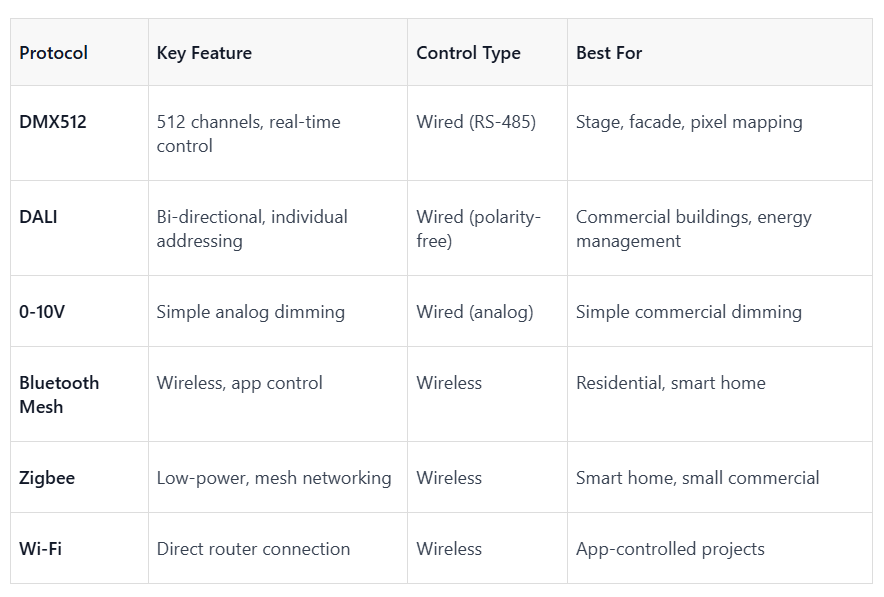
Choosing the Right Control Protocol: A Quick Comparison
How to Choose the Right Control Partner
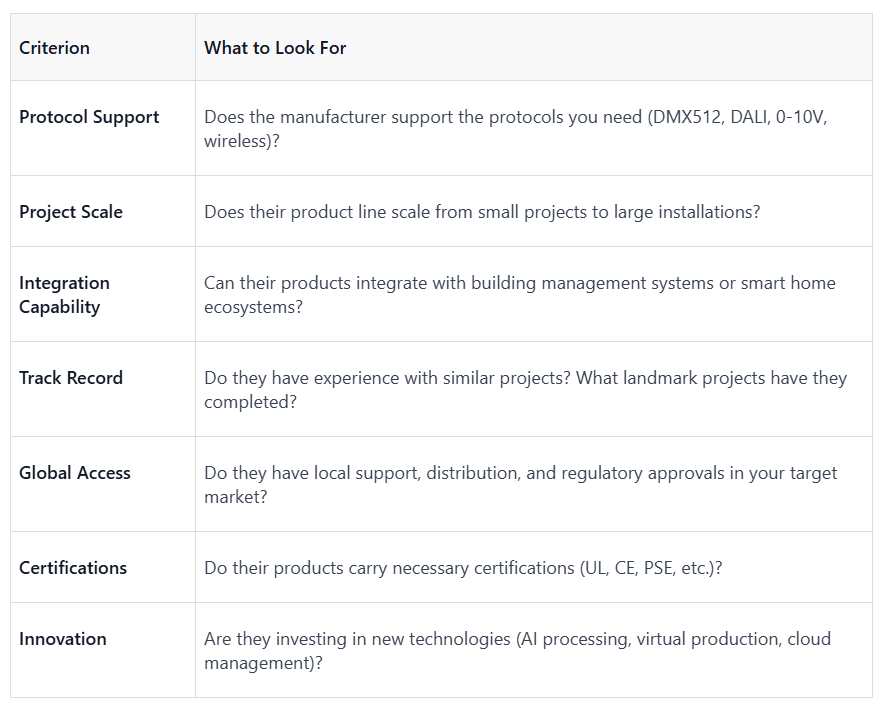
When selecting a control partner for your LED project, consider these key criteria:
Technical Specifications to Specify
When documenting your LED controller requirements, include the following:
LED Controller Specification Requirements:
Control Protocol: [DMX512 / DALI / 0-10V / Wireless / Hybrid]
Control Channels: [Number of channels or universes required]
Communication: [Wired / Wireless / Both]
Max Load: [Number of fixtures or pixels supported]
Control Interface: [DMX console / PC software / App / Building management system]
Power Supply: [Voltage and current requirements]
Environmental Rating: [Indoor / Outdoor / IP rating]
Certifications Required: [UL, CE, PSE, etc.]
Conclusion
The right controller is the key to unlocking the full potential of your LED lighting project. Whether you need the real-time precision of DMX512 for stage lighting, the building integration of DALI for commercial spaces, or the convenience of wireless control for residential projects, choosing the right partner ensures reliable, future-proof performance.
Our control solutions are designed to integrate seamlessly with your project requirements—whether simple or complex, wired or wireless, indoor or outdoor.
Related Content
Contact Us
Need help selecting the right control solution for your LED project? Our engineering team can analyze your requirements and recommend the optimal control protocol and system architecture.