
Posted August 1, 2026 | Category: Comparative Analysis | Tags: Control Protocols, DMX512, DALI, 0-10V
Quick Answer
The right control protocol depends on your project's complexity and goals. For simple dimming needs in a single space, 0-10V is the most cost-effective choice. For commercial buildings requiring flexible grouping and integration with building management systems, DALI is the industry standard. For dynamic color-changing applications, stage lighting, or architectural effects that demand real-time response, DMX512 is the clear winner.
Protocol | Best For | Key Strength | Limitation |
|---|---|---|---|
0-10V | Single-zone dimming, retrofit projects | Low cost, simple installation | No feedback, limited scalability |
DALI | Commercial buildings, offices, hotels | Individual addressing, bidirectional communication | Slower response, requires programming |
DMX512 | Stage/theater, dynamic color, pixel control | Fast, real-time response, 512 channels/universe | Complex wiring, specialized knowledge required |
Understanding the Three Protocols
Before diving into the comparison, it helps to understand where each protocol came from and what it was designed to do.
0-10V: The Analog Veteran
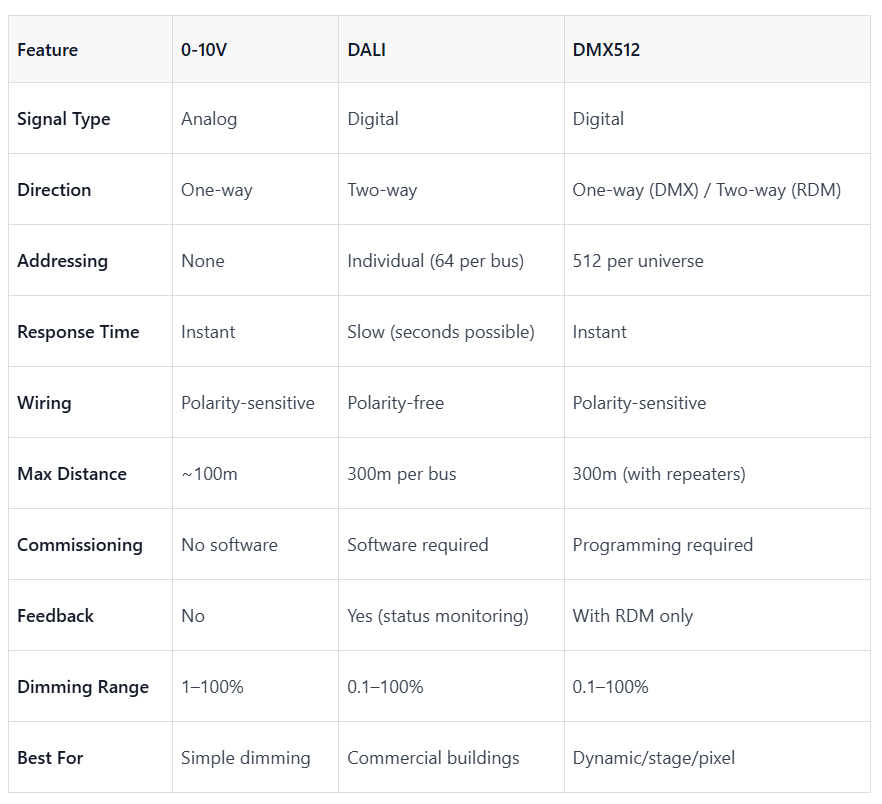
0-10V is the oldest and simplest of the three protocols — an analog dimming method that uses a low DC voltage signal to control light output. At 10V, the light is at 100% brightness; at 1V (or 0V in some systems), it dims to minimum or off .
Key characteristics:
Analog signal — brightness changes according to controlled voltage variations
Unidirectional — data flows only one way (controller to fixture)
Polarity-sensitive — wiring must be correct (DIM+ to DIM+)
No addressing — all connected fixtures respond identically to a command
Simple installation — requires no software commissioning
Typical applications: Single-zone dimming in offices, warehouses, and retail spaces — anywhere that needs basic dimming without complex control requirements. According to MOONS' Industries, a single 0-10V controller can accommodate about 10 luminaires .
Cost: Low — the most budget-friendly option for basic dimming needs.
DALI: The Digital Building Standard
DALI (Digital Addressable Lighting Interface) is a digital protocol specifically designed for building lighting control. It represents the transition from analog lighting to digital lighting . DALI-2 is the current standard, with stricter certification requirements ensuring interoperability between devices from different manufacturers .
Key characteristics:
Digital — enables precise dimming with standardized performance
Bidirectional — fixtures can report status back to the controller
Addressable — each device (up to 64 per DALI bus segment) has a unique address
Polarity-independent — wiring is not polarity-sensitive, reducing installation errors
Open standard — devices from different manufacturers can work together
Supports grouping and scenes — individual or group control
DALI-2 DT6 vs DT8: Within DALI-2, DT6 (Device Type 6) controls a single channel for simple dimming of fixed-white lighting. DT8 (Device Type 8) controls multiple channels with a single address, enabling tunable white, RGB, and RGBW control — ideal for human-centric and architectural lighting .
Typical applications: Commercial buildings, offices, hotels, museums, hospitals — anywhere that requires flexible grouping, individual control, and integration with building management systems .
Cost: Moderate — higher upfront cost than 0-10V, but lower long-term maintenance costs due to easier reconfiguration.
Limitations: Maximum 64 devices per bus segment; slower response time compared to DMX (a few seconds delay possible); requires software commissioning and specialized knowledge .
DMX512: The Dynamic Performance Protocol
DMX512 (Digital Multiplex 512) originated in the theater industry and has become the universal standard for dynamic, high-performance lighting control — now widely used in architectural applications .
Key characteristics:
Digital — professional-grade control with 256 levels per channel
Unidirectional (DMX) or bidirectional (DMX with RDM)
High channel capacity — 512 channels per universe, expandable with multiple universes
Almost instant response — no noticeable delay
Explicit addressing — each fixture has a specific address independent of physical position
Requires terminator — 120Ω resistor at the end of the line
DMX vs SPI: For addressable LED strips, DMX uses explicit addressing (like a mail carrier delivering to specific house numbers), while SPI uses positional addressing (like a telephone game, where a failure downstream affects everything after it) .
Typical applications: Stage and theater lighting, concert tours, architectural dynamic lighting (facades, bridges, pixel mapping), houses of worship, and any application requiring real-time color changes or complex effects .
Cost: Higher — requires specialized cabling, controllers, and expertise.
Limitations: Complex installation requiring specialized knowledge; special cables (EIA-485 or CAT5E); individual programming of drivers (without RDM) .
Head-to-Head Comparison
How to Choose: A Decision Framework
Choose 0-10V if:
Your project requires simple dimming in a single zone (or small number of zones)
You're working with a limited budget
You need quick, easy installation without software configuration
The project is a retrofit of an existing space
You don't need feedback, monitoring, or complex grouping
You have 10 or fewer luminaires per control zone
Choose DALI if:
Your project is a commercial building, office, hotel, or healthcare facility
You need individual addressing and flexible grouping of fixtures
Integration with building management systems is required
You want status monitoring and feedback from fixtures
Future reconfiguration without rewiring is important
You have more than 10 luminaires in a single control area
You need scene control and daylight harvesting integration
Choose DMX512 if:
Your project involves dynamic color-changing (RGB, tunable white, pixel control)
You need almost instant response for live events or interactive installations
It's a stage, theater, concert, or house of worship application
You're creating an architectural facade with pixel mapping
You need to control more than 64 devices in a coordinated way
You have the budget and expertise for specialized installation
Protocol Evolution: What to Watch
DALI-2 and DT8
DALI-2 is now the recommended standard, offering stricter certification and better interoperability. DT8 drivers support tunable white and color control with a single address, making them ideal for human-centric lighting and dynamic commercial spaces .
RDM (Remote Device Management)
RDM adds bidirectional communication to DMX, enabling automatic addressing and status reporting — bridging the gap between DMX's performance and DALI's feedback capabilities .
Wireless Protocols
For applications where wiring is difficult, wireless protocols like ZigBee and Bluetooth Mesh are becoming increasingly common for residential and small commercial projects .
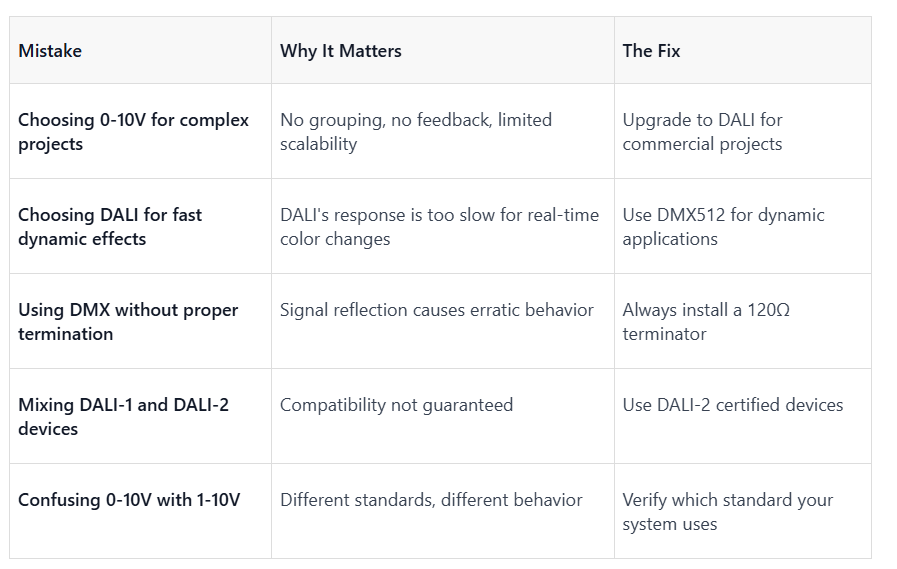
Common Mistakes to Avoid
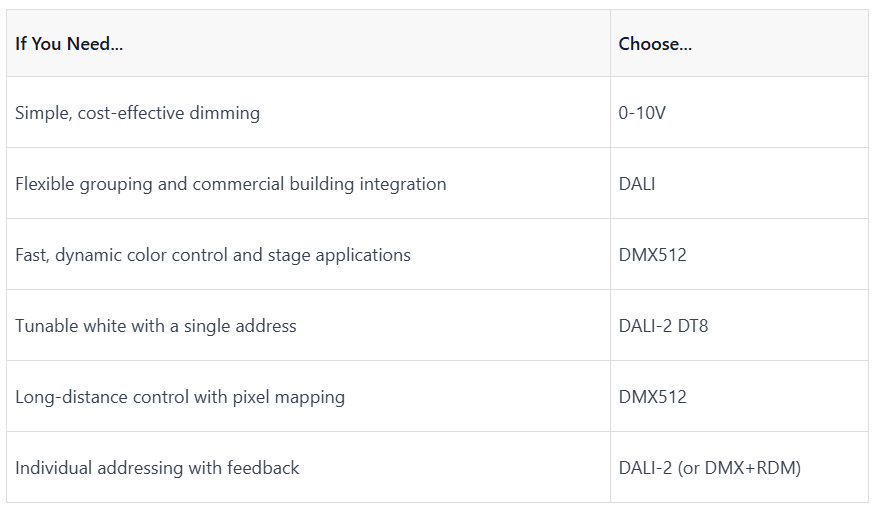
Summary
Related Content
Contact Us
Need help selecting the right control protocol for your LED project? Our engineering team can analyze your requirements and recommend the optimal solution.