
Estimated reading time: 5 minutes
Quick Answer
SPI pixel lights are increasingly specified for Stage Backdrop LED Curtain projects — but the gap between a working sample and a reliable stage installation is wider than most specifiers expect. The three most common mistakes are: ignoring the 300-LED power injection limit, specifying SK6812 without checking camera compatibility, and assuming IP67 on the pixel means the whole curtain is outdoor-ready. Get these three right, and the curtain performs. Get them wrong, and you'll be troubleshooting on show day.
Introduction
SPI pixel lights are a strong choice for Stage Backdrop LED Curtains. The appeal is obvious: per-pixel addressing, low power consumption, and a pixel pitch that turns a fabric backdrop into a low-resolution display.
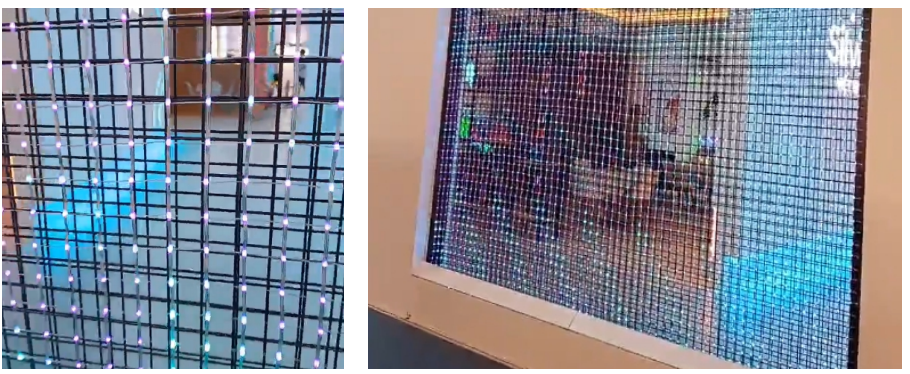
Based on our XXA-MESH-P50 SPI pixel light (DC 12V, SK6812, 5cm pitch, 400 pixels/m²), here are the three mistakes we see most often — and how to design around them.
Mistake 1: Ignoring the 300-LED Power Injection Limit
The spec says: "which can make 300pcs led with one end powered."
The mistake: Treating 300 LEDs as a target rather than a ceiling. On a Stage Backdrop LED Curtain, strings are often run vertically across the full height of the backdrop. A 5cm pitch over a 15m drop means 300 LEDs per line — exactly at the limit.
At 0.108W per LED, 300 LEDs draw roughly 32.4W per string. That is manageable. But push beyond 300 LEDs on a single feed, and you get:
Consequence | What Happens |
|---|---|
Voltage drop | Color shift at the far end (warm white turns pink, blue dims) |
Data corruption | Flickering or stuck pixels on the SPI line |
Heat buildup | Reduced LED lifespan at the injection point |
The fix: Design your curtain in 300-LED segments with dedicated power injection at each segment start. For a 400 pixels/m² layout, calculate total strings first, then map power injection points before specifying the controller. Do not assume one power supply per curtain — map it per line.
Rule of thumb for this fixture: 1 power injection point per 300 LEDs. Never cascade.
Mistake 2: Specifying SK6812 Without Checking Camera Compatibility
The spec says: "controlled by standard SPI protocol (SK6812 chip)."
The mistake: SK6812 is a reliable, widely supported SPI chip. But it is not a high-refresh-rate chip by default. On camera — especially at 50Hz or 60Hz shutter speeds — low-refresh SPI can produce rolling shutter banding, flicker, or partial frame capture.
For a Stage Backdrop LED Curtain used in:
Live broadcast
Filmed performances
Hybrid events with IMAG (image magnification)
...this is a dealbreaker. The audience in the room sees smooth animation. The audience at home sees a strobing mess.
The fix: If the backdrop will be filmed, confirm the PWM refresh rate of the SK6812 variant you are using. For camera-facing work, specify a high-refresh version (typically 2kHz+). If the supplier cannot provide a refresh rate figure, assume it is not camera-safe.
For pure live-audience applications — concerts, clubs, theatre without broadcast — standard SK6812 is fine. Match the chip to the capture requirement, not just the control protocol.
Mistake 3: Assuming IP67 Means "Outdoor-Ready" for the Whole Curtain
The spec says: "Waterproof Grade: IP67."
The mistake: IP67 on the pixel light does not mean the assembled curtain is IP67. The rating applies to the sealed LED bulb and its molded cable joint. It does not cover:
Component | Typical Rating | Outdoor Requirement |
|---|---|---|
SPI pixel light (XXA-MESH-P50) | IP67 | OK |
Controller | IP20 | Needs IP65+ enclosure |
Power supply | IP20 | Needs IP65+ enclosure |
Inter-string connectors | Varies | Specify IP67 connectors |
Fabric backdrop | FR, not waterproof | Needs rain cover or indoor use |
A Stage Backdrop LED Curtain specified as "IP67" and then deployed outdoors in rain will fail at the controller or the inter-string connector — not at the pixel.
The fix: Separate the rating by component. If the project is outdoor, specify IP65+ for controller and PSU, and plan cable routing so connectors sit above the water line.
Bonus: The Cutting Unit Mistake
The spec says: "Cutting unit every 1 led."
This is a genuine advantage — it allows precise sizing of the Stage Backdrop LED Curtain to odd stage dimensions. But it also means:
Every cut point is a potential failure point if not resealed
Custom cutting invalidates the IP67 rating unless the new end is properly capped
The 2-year warranty may not cover field-cut strings
The fix: Order pre-cut lengths from the supplier where possible. If field cutting is unavoidable, use the manufacturer's specified end caps and sealant, and document the cut for warranty purposes.
Quick Checklist Before You Specify
Check | Question to Answer |
|---|---|
Power | How many LEDs per string? Is it ≤300? |
Injection | Where are the power injection points? |
Camera | Will this be filmed? If yes, refresh rate? |
Control | Art-Net, offline, or TTL? Match to existing console. |
Environment | Indoor or outdoor? Controller/PSU rated accordingly? |
Cutting | Pre-cut or field-cut? Who reseals? |
Warranty | Does cutting void the 2-year coverage? |
Conclusion
SPI pixel lights are a strong choice for Stage Backdrop LED Curtains — the XXA-MESH-P50's 5cm pitch, 400 pixels/m², and per-LED cutting give designers real flexibility. But the failures we see are rarely about the pixel itself. They are about power architecture, camera compatibility, and environmental rating scope.
Get those three right, and the curtain performs. Get them wrong, and you will be troubleshooting on show day.
Related Content
Need Help with Your SPI Pixel Layout?
Need a second opinion on your SPI pixel layout? Contact our engineering team with your stage dimensions, viewing distance, and camera requirements. We will map power injection and controller placement before you commit to a specification.
Frequently Asked Questions
How many SPI pixel lights can run on one power injection?
For the XXA-MESH-P50 SPI pixel light (DC 12V, 0.108W/LED, SK6812), a maximum of 300 LEDs can be powered from one end. Exceeding 300 LEDs on a single feed causes voltage drop, color shift, data corruption, and heat buildup at the injection point. For Stage Backdrop LED Curtain projects, design in 300-LED segments with dedicated power injection at each segment start.
Is SK6812 suitable for stage backdrops that will be filmed or broadcast?
Standard SK6812 SPI chips may produce rolling shutter banding, flicker, or partial frame capture on camera at 50Hz or 60Hz shutter speeds. For filmed or broadcast Stage Backdrop LED Curtain applications, specify a high-refresh SK6812 variant (typically 2kHz+ PWM refresh rate) . For live-audience-only use, standard SK6812 is acceptable. Always confirm the PWM refresh rate with your supplier before specifying for camera-facing work.
Does IP67 on SPI pixel lights mean the whole LED curtain is waterproof?
No. IP67 applies only to the sealed pixel light and its molded cable joint. The controller (Art-Net or TTL) and power supply are typically IP20, and inter-string connectors vary. For outdoor Stage Backdrop LED Curtain installations, specify IP65+ enclosures for the controller and PSU, use IP67 connectors, and route cables so connectors sit above the water line. The flame-retardant fabric itself is not waterproof.
Can SPI pixel light strings be cut to custom lengths for a stage backdrop?
Yes. The XXA-MESH-P50 has a cutting unit of every 1 LED, allowing precise sizing for odd stage dimensions. However, every cut point is a potential failure point if not resealed, field cutting voids the IP67 rating unless properly capped, and the 2-year warranty may not cover field-cut strings. Order pre-cut lengths from the supplier where possible, or use manufacturer-specified end caps and sealant.