
Estimated reading time: 9 minutes
Quick Answer
When designing theme park lighting and parade LED lights, off-the-shelf residential products are insufficient. You must specify commercial-grade custom shaped RGB modules that offer high IP ratings (IP65/IP67) for outdoor durability. Successful float lighting design relies on lightweight, low-voltage modular systems and wireless DMX512 control to synchronize complex light shows with music. Ultimately, the goal of amusement park night lighting is to extend operating hours and create immersive, photogenic environments that drive social media engagement and repeat visits.
Introduction: Extending the Magic Beyond Daylight
For theme parks and amusement parks, the sun setting is not the end of the day — it is the beginning of a completely different experience. Nighttime is when the magic truly comes alive through amusement park night lighting.
Whether it is a dazzling nightly parade, a themed dark ride, or a beautifully illuminated castle, the lighting is a critical part of the storytelling. However, specifying lighting for this environment is a massive technical challenge. Fixtures must withstand:
Extreme weather
Constant vibration from moving floats
The rigorous demands of nightly operation
This technical guide walks you through the essential specifications for choosing the best theme park lighting and parade LED lights.
1. The Core Technology: Custom Shaped RGB Modules for Immersive Design
In a theme park, lighting is not just about illumination; it is about creating shapes, characters, and illusions.
Beyond Standard Strings
Standard linear lights cannot create a glowing pumpkin, a magical fairy wing, or a futuristic spaceship. This is where custom shaped RGB modules come in. These are flexible LED boards or pixel-mapped strips encased in custom-molded acrylic or polycarbonate diffusers.
Pixel Mapping and DMX512
To achieve dynamic, flowing effects (like a glowing dragon breathing fire), you need pixel-mapped LEDs. Each individual LED (or small cluster) can be controlled independently via DMX512 or Art-Net protocols. This allows for stunning video-like effects on 3D surfaces.
High Brightness for Ambient Light
Unlike indoor lighting, theme park lighting must compete with:
Streetlights
Ride illumination
Projection mapping
You need high-lumen output modules to ensure your custom shapes "pop" against a busy background.
2. Engineering for Motion: Float Lighting Design Essentials
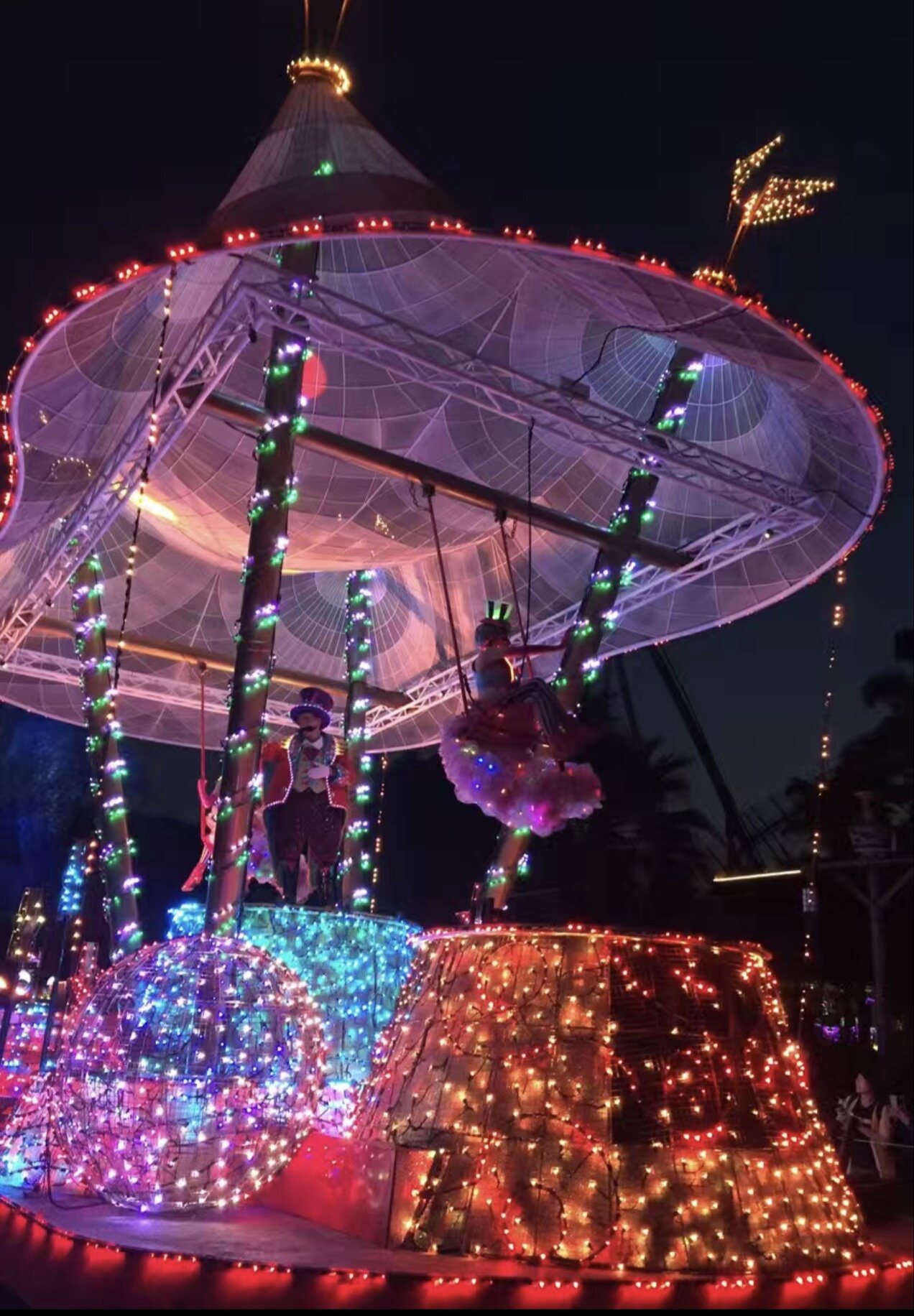
Parade floats are unique engineering marvels. They are moving buildings that must be lightweight, safe, and visually spectacular. Float lighting design requires a specialized approach:
Vibration Resistance
Floats vibrate constantly as they move along the parade route. Standard LED modules with simple plug-in connectors will quickly loosen and fail. You must use modules with:
Locking waterproof connectors
Secure mounting hardware (screws, not just adhesive)
Low Voltage & Battery Power
Floats cannot be tethered to a wall outlet. They rely on onboard generators or large battery banks. Therefore, your parade LED lights must be highly energy-efficient. Low-voltage (12V or 24V) DC systems are the industry standard for safety and efficiency.
Wireless DMX Control
Running data cables through a moving, rotating float is a recipe for disaster. Wireless DMX512 transmitters and receivers are essential for float lighting design, allowing the lighting operator to sync the float's lights perfectly with the parade music and other floats.
Lightweight Materials
Every ounce counts on a float. Custom-shaped modules should use lightweight aluminum or high-impact plastics to reduce overall weight and extend battery life.
3. Durability and Safety: The Backbone of Amusement Park Night Lighting
Theme parks operate rain or shine, 365 days a year. Your lighting investment must be protected.
IP65/IP67 Ratings
For amusement park night lighting, every outdoor fixture must be at least IP65 rated. For water-based rides or areas prone to heavy rain and splash zones, IP67 or even IP68 is required.
Rating | Protection | Best For |
|---|---|---|
IP65 | Water jets | General outdoor use |
IP67 | Temporary immersion | Splash zones, water rides |
IP68 | Continuous immersion | Fountains, submerged fixtures |
UV Stability
The sun is brutal on plastics and rubbers. Ensure your custom modules use UV-stabilized materials to prevent:
Yellowing
Cracking
Degradation of light output
Safety First (Low Voltage)
With thousands of guests, including children, walking around the attractions, safety is paramount. Always specify low-voltage (e.g., 24V) systems. This eliminates the risk of electric shock if a wire is accidentally damaged. All fixtures must be securely mounted to prevent them from falling onto guest pathways.
4. Control and Synchronization: The Brain of the Operation
A theme park's night lighting is a choreographed performance. It must be perfectly synchronized with audio, animatronics, and fountain shows.
Timecode and Show Control
Your lighting system must be able to interface with a central show control system (like Medialon or Alcorn McBride). This allows the lights to trigger at exact moments using SMPTE timecode.
RDM (Remote Device Management)
With thousands of fixtures across a massive park, manual maintenance is impossible. RDM allows technicians to remotely monitor:
Fixture temperature
Power consumption
Error codes
This drastically reduces downtime and maintenance costs.
FAQ: Theme Park & Parade Lighting
Can we use standard outdoor Christmas lights for a theme park parade?
No. Standard holiday lights are not designed for the constant vibration, weather exposure, and rigorous nightly use of a parade. They will fail quickly. You need commercial-grade parade LED lights specifically engineered for mobile and high-durability applications.
How do you power lights on a parade float?
Floats typically use onboard diesel generators or large lithium-ion battery banks. Because battery power is limited, float lighting design heavily prioritizes energy-efficient LED technology and low-voltage DC systems to maximize the duration of the parade.
What is the best way to create a glowing character costume for a theme park?
This requires highly flexible, lightweight custom shaped RGB modules or pixel-mapped LED strips. These are often embedded into the costume's fabric or armor and powered by small, wearable battery packs, controlled via wireless DMX or a local microcontroller.
Why is DMX512 important for theme park lighting?
DMX512 allows hundreds of individual fixtures to be controlled from a single console. For theme park lighting, this means:
Synchronized light shows across multiple attractions
Dynamic color changes for seasonal events
Integration with music and show control systems
What IP rating is required for water-based theme park rides?
For water-based rides, splash zones, and areas prone to heavy rain, specify IP67 or IP68. IP65 is sufficient for general outdoor lighting, but water-contact applications require higher protection.
Summary
Consideration | Recommendation |
|---|---|
Module type | Custom shaped RGB modules with pixel mapping |
Control | DMX512, Art-Net, wireless DMX for floats |
IP rating | IP65 minimum; IP67/IP68 for water exposure |
Voltage | Low-voltage (12V/24V) DC |
Materials | UV-stabilized, lightweight aluminum or plastic |
Mounting | Locking connectors, secure hardware |
Maintenance | RDM for remote monitoring |
Show control | SMPTE timecode integration |
Related Reading
LED Festival Lighting: How to Calculate Power Supply and Cable Length for Large Displays →
Custom 45mm RGBW Cabochon Pixel Light – 2-Sided Illumination, UCS8904B, Indoor/Outdoor →
Custom DC12V Copper Wire LED Strings – Warm White, Flexible, and Built to Last →
Need Theme Park or Parade Lighting for Your Project?
We supply professional Festival Lighting Solutions — featuring durable custom shaped RGB modules and advanced control systems designed specifically for the rigorous demands of theme park lighting and float lighting design.
👉 Contact Us Today for samples, technical support, or a quote.