
Estimated reading time: 8 minutes
Quick Answer
A Pool Coping LED Strip is a linear lighting solution installed at the waterline — the edge where the pool meets the deck. Unlike standard underwater lights, it must withstand intermittent submersion, foot traffic, chemical exposure, and UV year-round. To survive this environment, specify IP68 construction, walkover-rated housing, chlorine and saltwater resistance, and 24V DC for long runs. Recessed aluminum channels offer the most durable installation.
Introduction: Why Pool Edge Lighting Is Different
Lighting a swimming pool is no longer just about a glow in the water. The most striking, professional installations today focus on the pool coping — the edge where water meets deck. A Pool Coping LED Strip turns that boundary into a clean, continuous line of light that defines the pool's shape, improves safety, and elevates the entire backyard after dark.
But specifying a strip for this location is not the same as choosing a standard underwater light. The pool edge is a harsh environment: it gets stepped on, splashed with chlorinated or salt water, baked by UV, and must often sit flush inside stone or a mounting profile.
This guide covers everything you need to know — from the right specs to installation methods and common mistakes.
Why Pool Edge Lighting Is Different
Most pool lighting falls into two categories: submerged lights (inside the wall) and perimeter lighting (around the deck). Pool coping LED strip sits in a third, more demanding zone — the waterline itself.
At the waterline, a strip must handle:
Challenge | Why It Matters |
|---|---|
Intermittent submersion | Splashing and wave action |
Foot traffic | Stepping on the coping stone or deck |
Chemical exposure | Chlorine, salt, and pH-balancing agents |
UV radiation | Direct sunlight year-round |
Thermal cycling | Hot days and cool nights |
That combination rules out ordinary IP65 or even many IP67 strips. For a waterline LED strip to survive, you need IP68 construction plus additional mechanical protection.
Key Specs to Look For
1. IP68 — But Don't Stop There
IP68 LED strip is the baseline for any pool edge application. However, IP68 alone does not guarantee the strip can be walked on. Look for:
Specification | Why It Matters |
|---|---|
Walkover Rated / Walkable | Rated for foot traffic |
IK08 / IK10 impact resistance | Protects against dropped objects and heels |
Anti-Slip surface | Critical if the strip is exposed on the coping surface |
2. Chemical and UV Resistance
A pool edge strip should be explicitly rated:
Chlorine Resistant
Saltwater Pool Rated
UV Stable
Silicone extrusion is generally preferred over PVC or PU for long-term UV and chemical stability.
3. Voltage: Choose 24V for Long Runs
For custom length and continuous run installations, 24V DC is the better choice. It suffers less voltage drop than 12V, allowing longer straight runs without visible dimming at the end.
4. Dot-Free, Uniform Light
Nothing looks worse on a pool edge than visible LED dots. Specify:
Dot Free / Seamless
Uniform Linear Light
COB LED Strip or Silicone Neon Flex for the smoothest output
5. Color and Control
Option | Best For |
|---|---|
RGBW or Tunable White | Flexible scene setting |
DMX512 or DALI | Large pools with centralized control |
Addressable | Animated effects along the coping |
Installation Methods for Pool Coping
How you mount the strip determines which products you need.
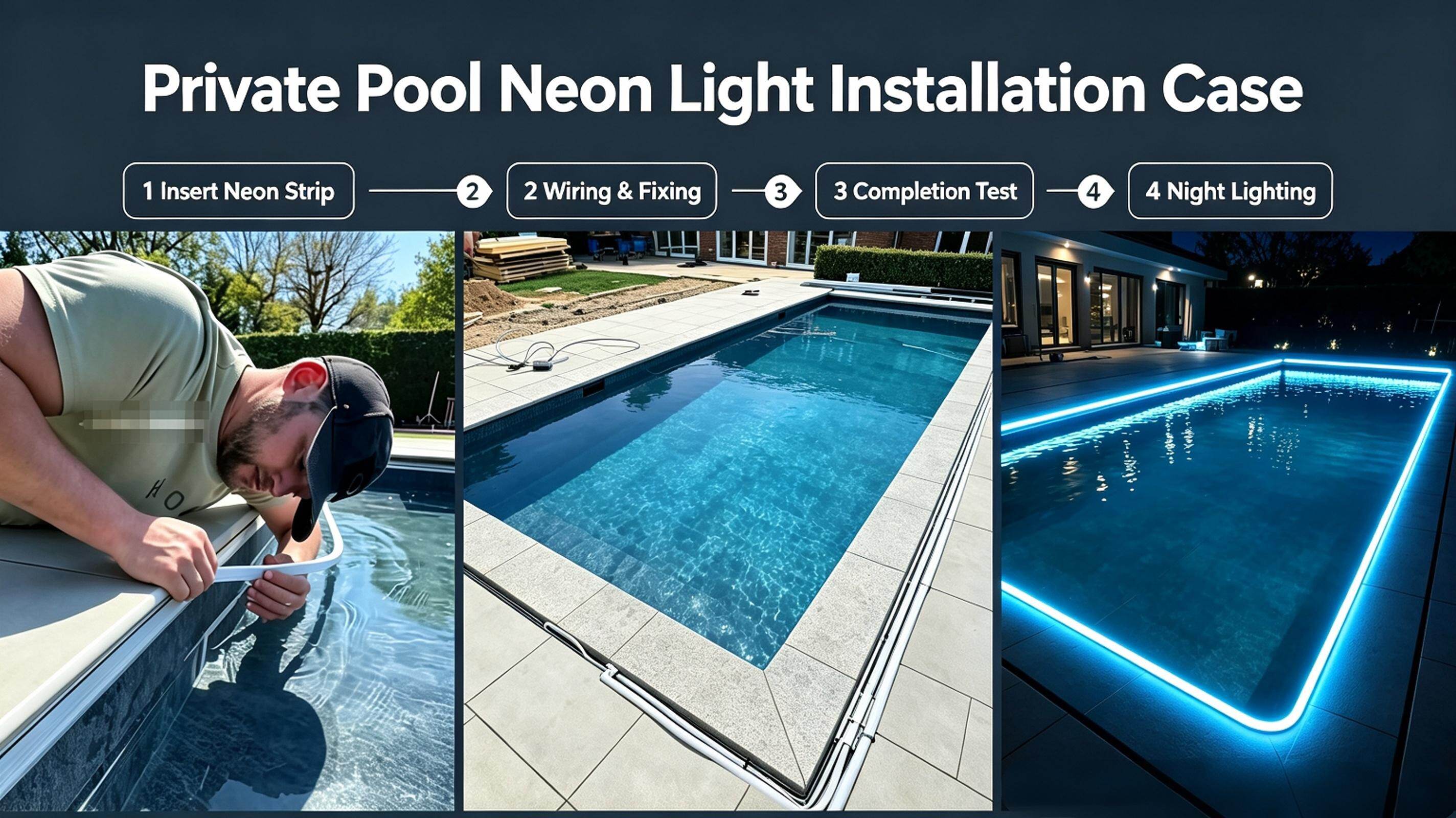
Recessed / Concealed Installation
The most common and most durable approach. The strip sits inside an aluminum channel or a pre-cut groove in the coping stone.
Keywords: Recessed LED Strip, Concealed LED Strip, Hidden LED Strip, Flush Mount, Aluminum Channel, Mounting Profile
This method protects the strip from direct foot impact and gives a clean, architectural line.
Surface-Mounted on Coping
Used when the coping is already installed and cannot be cut. Requires a walkable and anti-slip strip, often with a low-profile mounting profile.
Keywords: Surface Mount LED Strip, Walkover Rated, Anti-Slip, Paving Light, Deck Light
Embedded in Paving / Deck
For pool decks with pavers, the strip can be integrated into the paving joints.
Keywords: Paving Light, Deck Light, In-ground LED Strip
Bending and Layout Considerations
Most pool edges are straight, but corners and curves require planning.
Consideration | Description |
|---|---|
Horizontal Bend | For flat turns along the coping plane |
Vertical Bend | For changes in height or step edges |
Corner Connector | For clean 90° transitions |
Continuous Run | Minimizes joints and failure points |
Important: Some high-protection custom strips are not cuttable after factory sealing. If you need field adjustability, confirm Free Cut capability before ordering — and understand that cutting may void IP68 protection unless the end is properly re-sealed.
Common Mistakes to Avoid
Mistake | Consequence |
|---|---|
Using IP67 instead of IP68 | Fine for splashes, not for waterline duty |
Ignoring walkover rating | A strip can be waterproof and still fail under foot traffic |
Skipping the aluminum channel | Bare strip on coping rarely lasts |
Choosing 12V for long runs | Expect dimming at the far end |
Assuming all strips are cuttable | Many custom IP68 strips are sealed for life |
Forgetting UV and chlorine ratings | These are not optional at the pool edge |
Summary
Consideration | Recommendation |
|---|---|
IP Rating | IP68 minimum |
Impact Resistance | IK08 or IK10 |
Walkability | Walkover rated, anti-slip |
Chemical Resistance | Chlorine and saltwater rated |
Voltage | 24V DC for long runs |
Light Quality | Dot-free, COB or silicone neon flex |
Installation | Recessed aluminum channel (preferred) |
Control | RGBW, DMX512, or DALI for larger pools |
Related Content
Client Story: Pool Neon Lighting with 20×14 Top-View Neon Flex →
Custom 20×14 Top-View Neon with RGBW LED Strip – 60 LEDs/m, DC24V, IP67–68 →
Looking for a Custom Pool Coping LED Strip?
We supply custom-length, IP68, walkover-rated pool coping LED strips — with options for COB, silicone neon flex, and DMX512 control.
👉 Contact Us Today for specification support and samples.